




 22 Min
 In Pharmacy First

Follow this topic

Bookmark

Record learning outcomes
Diagnosis and management of shingles
This toolkit is designed to support pharmacists and their teams deliver the Pharmacy First servie in England (and similar schemes in the UK) for shingles. It covers:
- Assessment and decision-making about shingles
- Management of the condition
- Red flags and vaccination.
|
After completing this toolkit you will be able to:
|
|
||||||||||||
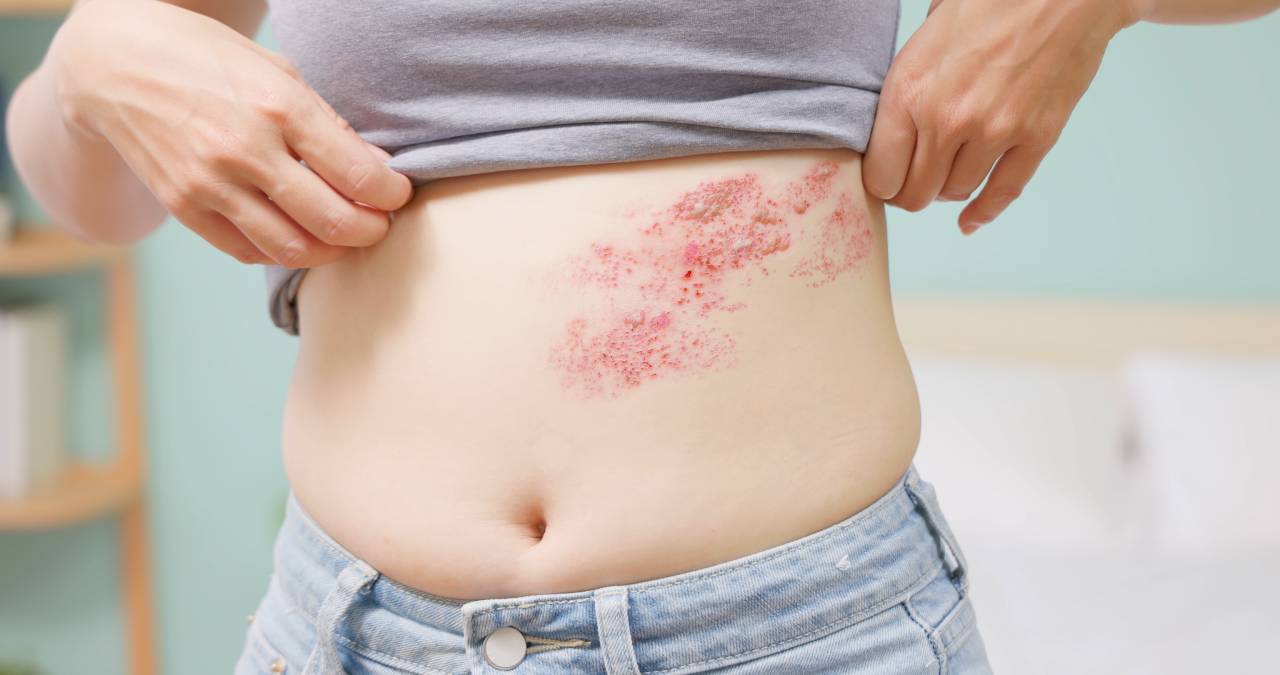
Shingles (herpes zoster) is a viral infection that affects sensory nerves and the skin surface served by those nerves (dermatomes).
It can be a challenge to diagnose as the pain can precede the rash by several days. Once the rash has appeared, it does usually have a vesicular appearance and often patients will attend the pharmacy already suspecting they have shingles.
Treatment timetables are important when dealing with shingles. The sooner that antivirals are prescribed for eligible patients, the less likely it is that they will suffer post-herpetic neuralgia. This means treating all those over the age of 50 years with antivirals.
The risk of developing shingles increases as a person gets older and it predominantly affects those over 70 years of age, although it is sometimes seen in young people and children. Shingles is a reactivation of a previous chickenpox (varicella zoster) infection, sometimes from decades ago.
Post-herpetic neuralgia (PHN) occurs in up to a third of people with shingles, causing severe and debilitating pain, which can be long-lasting. It is defined as pain persisting for more than 90 days after rash onset and is more common, and tends to be more severe, in older people.
The overall annual incidence in the UK is estimated to be 1.85-3.9 cases per 1,000 population, increasing with age from less than two cases per 1,000 in people younger than 50 years to 11 cases per 1,000 in people aged 80 years or older. The lifetime risk of developing shingles is 20-30% and the risk increases with age.
The provision of antiviral medication (aciclovir and valaciclovir) from community pharmacies has the potential to improve access to treatment within the crucial three-day period after the shingles rash appears. This early intervention can help reduce the severity and duration of shingles.
There is also good evidence that shingles vaccine can prevent the disease in older people.
|
Risk factors for shingles
|
Is it shingles?
Many patients describe a prodromal phase with abnormal skin sensations and pain in the affected dermatome (an area of skin served by an individual nerve root).
The pain can be described as burning, stabbing or throbbing, can be intermittent or constant, and may be so severe that it interferes with sleep and quality of life. Headache, photophobia, malaise and fever (less common) may also occur as part of the prodromal phase.
If patients are seen at this point, it can be difficult to be sure of the cause in the absence of a rash. A good policy is to ask the patient to return straight away if a rash occurs. Some GPs will start oral antiviral therapy if they believe shingles is imminent (although this use is controversial).
Within two to three days (sometimes longer), a rash typically appears in a dermatomal distribution.
The rash starts as maculopapular (red, raised) lesions, then develops into clusters of vesicles (small blisters), with new vesicles continuing to form over three to five days, before resolving over seven to 10 days. The vesicles burst and this releases varicella zoster virus. The rash is usually itchy and tingly and can be very painful. Unlike most other rashes, it is unilateral — either on the left or right side of the body — and does not usually cross the mid-line of the body, but there may occasionally be a slight spread to the other side around the skin over the spine.
Healing of the affected skin occurs over two to four weeks and the damage from infection can cause scarring and permanent pigmentation.
Most cases of shingles involve the thorax, trunk and abdomen. A problem with diagnosis is the extent to which the rash can vary. This is why PGDs for community pharmacy supply of aciclovir and valaciclovir are very specific about the scope of the infection and which patients can be treated.
The rash may be atypical in certain groups — for example, older people (in whom the rash may not be vesicular) and in immunocompromised patients, when the rash may be severe or long-lasting. Symptoms can also be more widespread for immunocompromised people and affect multiple dermatomes.
Although pain is a common feature, some people, particularly younger patients, suffer little discomfort. If there is doubt over the diagnosis, these cases should be referred to a GP, alongside those in whom there are red flags.
Chickenpox and shingles
Primary infection with varicella zoster virus, usually during childhood, causes chickenpox. Although chickenpox typically presents with easily identified signs and symptoms, some cases are mild and may not be recognised.
Chickenpox in adults can be more severe. If seen within 24 hours of the rash starting an antiviral may be given, so adult patients with early chickenpox should be referred to a prescriber.
After the initial infection, the virus can settle in the body and remain dormant within the sensory nerve roots of the spinal cord or cranial nerves. Reactivation, years and sometimes decades later, is what causes shingles, with a lifetime risk of between 20-30%.
It is thought that something 'triggers' the virus to reactivate — usually an intercurrent illness, particularly in those who are immunocompromised or on corticosteroids, but often it may not be identified. Stress and significant stressful lifetime events are often implicated.
There are several myths about the relationship between chickenpox and shingles. Community pharmacy teams have a role to play in explaining that:
- People do not "catch" shingles — it only appears in those who have previously been infected with chickenpox
- Those who have not had chickenpox cannot get shingles because there is no dormant infection to be reactivated
- Most adults will have had chickenpox — many will have had it during childhood and do not remember or were not aware of the diagnosis
- Shingles can be infectious and cause chickenpox in people who have not had it. Healthy people who have already had chickenpox will not be at risk.
Patients with suspected shingles should be advised to:
- Avoid contact with people who have not had chickenpox, particularly pregnant women, the immunocompromised (e.g. those on chemotherapy or corticosteroids) and babies younger than one month of age
- Avoid sharing clothes and towels
- Wash their hands often.
|
Differential diagnoses
|
Clinical progression to the Gateway Point
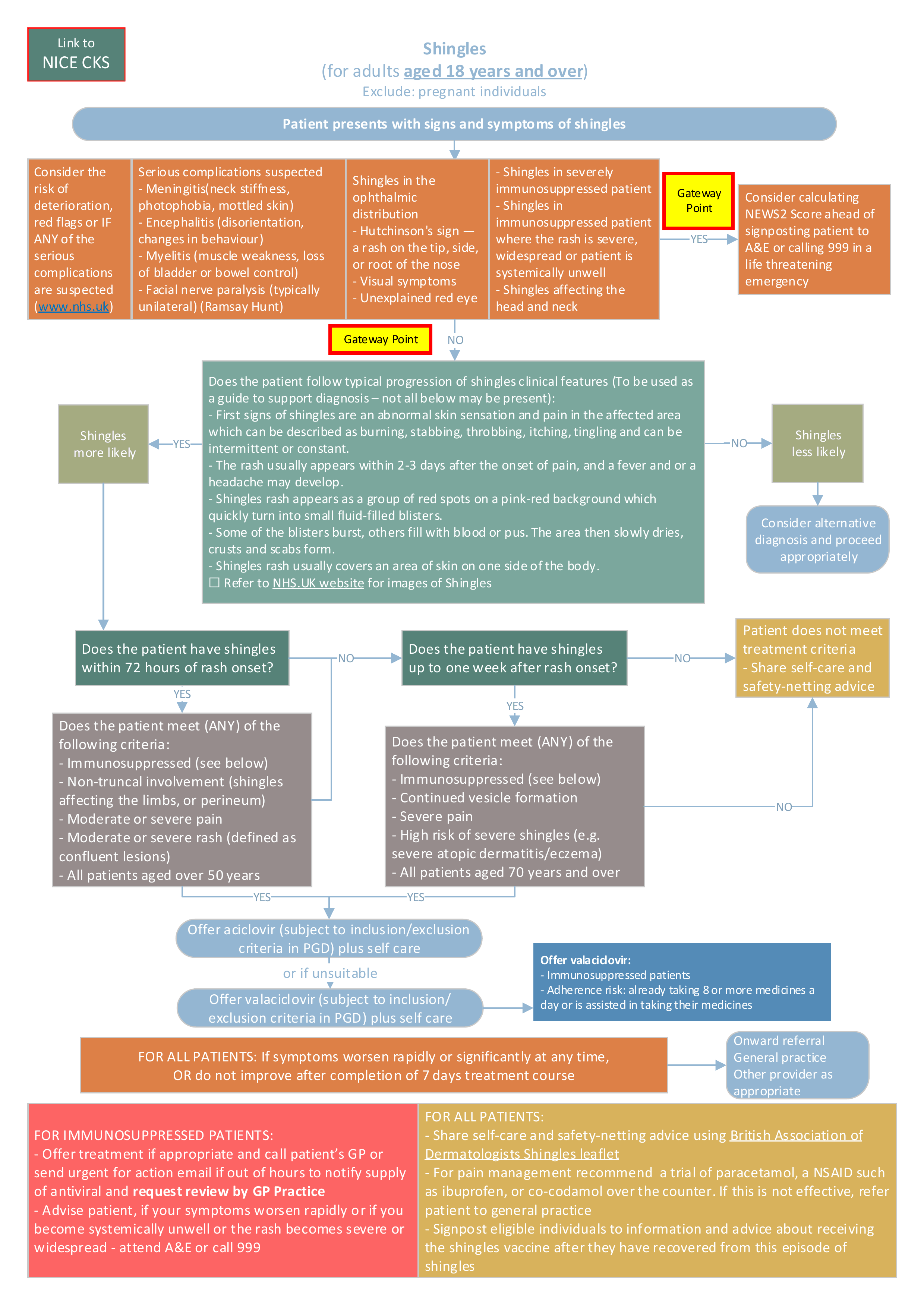
If patients show the clinical progression below, then shingles is likely:
- First signs of shingles are abnormal skin sensation and pain in the affected area, which can be described as burning, stabbing, throbbing, itching, tingling, and can be intermittent or constant
- The rash usually appears within 2-3 days after the onset of pain, and fever and/or headache may develop
- Shingles rash appears as a group of red spots on a pink-red background, which quickly turn into small fluid-filled blisters
- Some of the blisters burst; others fill with blood or pus. The area then slowly dries, crusts and scabs form
- Shingles rash usually covers a well-defined area of skin on one side of the body only (right or left) and will not cross to the other side of the body, in a dermatomal (area of skin served by an individual nerve root) distribution.
Red flags
The vast majority of cases of shingles are unlikely to be associated with severe complications. However, those involving the eyes, nose or ears that relate to cranial nerve involvement, those affecting multiple dermatomes and those with suspected bacterial superinfection need urgent same-day referral.
Immunocompromised patients, including those on systemic corticosteroids or chemo-therapy, should also be referred urgently.
The key red flags are:
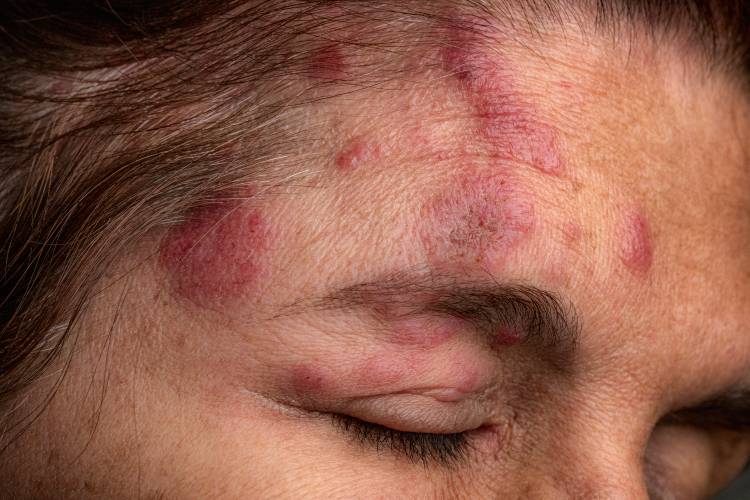
- Any involvement of the forehead, nose or eye (or with visual symptoms). Known as herpes zoster ophthalmicus infection, this affects the ophthalmic division of the trigeminal nerve, which also innervates the eyeball
- Hutchinson's sign (a rash on the tip, side or root of the nose) indicates an increased likelihood of eye inflammation and permanent corneal nerve damage or denervation. However, rarely it presents as an unexplained red eye without an obvious rash. Complications include keratitis, optic neuritis, retinitis, glaucoma and blindness, and it requires urgent specialist treatment
- Involvement of the ear. Herpes zoster oticus (Ramsay Hunt syndrome) occurs when the virus affects the facial nerve. The first sign is often deep, severe ear pain. It is characterised by lesions in the ear, facial paralysis (Bell's palsy), and associated hearing and vestibular symptoms
- Shingles in pregnancy. This may need antiviral treatment under specialist care
- A person who has suspected shingles where the rash is severe, widespread or they are systemically unwell (which may signify more widespread dissemination of the virus)
- Immunocompromised people and children who have suspected shingles
- Involvement of more than one dermatome
- Superinfection of skin lesions. Secondary infection of the lesions, usually with staphylococcal or streptococcal bacteria, may occur and rarely can result in cellulitis, osteomyelitis or life-threatening complications.
Treatment options and practical advice
Practical advice for managing shingles is to wear loose-fitting clothes to reduce irritation, and to cover lesions that are not under clothes with a non-sticky dressing while the rash is still weeping. Patients should be advised to avoid work, school or day care if the rash is weeping and cannot be covered. Since people could catch chickenpox from someone with shingles if they have not had it before, patients should try to avoid:
- Anyone who is pregnant and has not had chickenpox before
- People with a weakened immune system
- Babies less than 1 month old.
If the lesions have dried or the rash is covered, avoidance is not necessary.
Topical creams and adhesive dressings should generally be avoided as they can cause irritation and delay rash healing.
Other advice includes
- Keep the sores clean and dry, but do not use scented soaps or bath oils and do not rub too hard as this will delay healing
- Do not let dressings or plasters stick to the rash
- Use a cold compress several times a day (ice cubes or frozen vegetables wrapped in a tea towel or a gel ice pack) may also help.
Pain
The pain from shingles can range from mild to severe. Adults with mild pain can try paracetamol alone or in combination with codeine or ibuprofen. If this does not work or the person presents with, or develops, severe pain, referral is indicated.
Prescribers may offer a trial of treatment intended for neuropathic pain, usually amitriptyline (off-label use), duloxetine (off-label use), gabapentin or pregabalin.
Antivirals
For early cases of shingles, a course of oral aciclovir or valaciclovir may be used. There is evidence that the earlier treatment is started within 72 hours of rash onset, the more it may reduce the severity and duration of a shingles episode.
Pharmacists are now able to initiate this early treatment. Community pharmacy PGDs, for example in Scotland, make more specific requirements for treatment initiation, usually relating to restricting it to within 72 hours of onset, to those with a single affected dermatome on the torso and in patients aged over 18 years.
In England, both the aciclovir and valaciclovir PGDs list patient inclusion criteria as a diagnosis of shingles within 72 hours of rash onset AND ANY of the following:
- Non-truncal involvement (e.g. shingles affecting the limbs or perineum)
- Moderate or severe pain
- Moderate or severe rash (defined as confluent lesions)
- Aged over 50 years.
OR
Diagnosed with shingles within seven days of rash onset AND ANY of the following:
- Continued vesicle formation
- Severe pain
- High risk of severe shingles (e.g. severe atopic dermatitis/eczema)
- Aged 70 years and over.
Post-herpetic neuralgia
Following the rash, persistent pain at the site — post-herpetic neuralgia (PHN) — can develop. It is seen more frequently in older people and results from peripheral nerve damage caused by the herpes zoster virus. Pain that persists for 90 days or more after the onset of the rash is a commonly accepted definition for PHN.
On average, PHN lasts from three to six months, but can persist for longer, sometimes years. The severity of pain can vary and may be constant, intermittent or triggered by stimulation of the affected area, such as wind on the face (allodynia) [see panel, right].
The incidence of PHN is strongly related to age, ranging from 7% in people aged between 50-59 years to 21% of those aged 60-69 years; 29% aged between 70-79 years; and 34% in those over the age of 80 years.
|
||||||||||||||||||||
Vaccination
The most effective way of preventing PHN is with a herpes zoster (shingles) vaccine. Two vaccines are currently used in the NHS:
- Zostavax — a live attenuated vaccine given once
- Shingrix — a recombinant vaccine given twice (usually 6 to 12 months apart).
Studies have shown that giving older people (adults aged over 60 years) the vaccine boosts waning immunity and significantly reduces morbidity from both shingles and PHN. If shingles does develop, symptom severity is greatly reduced and the incidence of PHN drops by two-thirds.
Herpes zoster vaccines are usually well tolerated and recipients experience few systemic side-effects. Protection lasts for at least 10 years.
The NHS shingles vaccination programme began in 2013, using Zostavax, initially for patients aged over 70 years. As it is a live attenuated vaccine it is contraindicated in immunosuppressed people, pregnant women and children. In 2021 Shingrix was introduced for severely immunocompromised patients.
In the first five years of the routine programme using Zostavax in England (2013-18) there were significant reductions in hospitalisations for both shingles and PHN, and in consultations for PHN. These reductions were consistent with effectiveness in the routine cohorts (vaccinated aged 70+ years).
Overall, in England, an estimated 40,500 GP consultations and 1,840 hospitalisations were averted through vaccination with Zostavax.
Since September 2023 the provision of shingles vaccine by the NHS has changed — both in the product used and the age threshold. There is evidence that Shingrix has greater efficacy and provides a substantially longer duration of protection from shingles than Zostavax, although a drawback is that for a full response it has to be given in two doses at least eight weeks apart.
As it is a non-live recombinant vaccine it can be given to immunocompromised patients.
The Shingrix vaccine has replaced Zostavax in the routine shingles programme and so a two-dose schedule is now required for all patient cohorts. It can be safely given at the same time as the flu jab.
- For immunocompromised patients: the eligible cohort of patients has expanded to all patients aged 50 years and over (with no upper age limit). The programme aims to catch all severely immunocompromised individuals aged 50 years and over within the first year (see Green Book shingles chapter 28a for eligibility criteria). The second dose should be given eight weeks to six months after the first dose for this cohort
- For immunocompetent patients: The eligible cohort of patients will expand to all those aged over 60 years, implemented in two stages over 10 years. For these people, the second dose can be given six to 12 months after the first dose.
During stage 1 of the revised programme (September 2023 to August 2028), Shingrix will be offered to those turning 65 and 70 years on or after September 1, 2023.
Zostavax will be offered to people aged between 70 to 79 years that were eligible for the vaccination programme before September 1, 2023. Once all stocks of Zostavax are exhausted, these individuals can be offered Shingrix if they have not previously been given a shingles vaccine.
During stage 2 (September 2028 to August 2033): Shingrix will be offered to those turning 60 and 65 years of age. From September 1, 2033, and thereafter, Shingrix will be offered routinely at age 60 years.
Using the shingles PGDs
For patients who pass the Gateway Point there are two antiviral options for treatment, both for adults aged 18 years and over:
- Aciclovir
- Valaciclovir.
If the patient has been diagnosed with shingles within 72 hours of rash onset and any of the following, then offer aciclovir and self-care:
- Non-truncal involvement (shingles affecting the limbs or perineum)
- Moderate or severe pain
- Moderate or severe rash (defined as confluent lesions)
- All patients aged over 50 years.
If the patient has been diagnosed with shingles within seven days of rash onset and any of the following, then offer aciclovir and self-care:
- Continued vesicle formation
- Severe pain
- High risk of severe shingles (e.g. severe atopic dermatitis/eczema)
- All patients aged 70 years and over.
Valaciclovir can be offered to patients who are:
- Assisted in taking their regular medications (e.g. by visiting carers) where adherence with the five-time daily regimen for aciclovir would not be achievable OR who are already prescribed eight or more medicines per day where adherence with the regimen for aciclovir may not be achievable
- Immunosuppressed individuals diagnosed within seven days of rash onset where the rash is NOT widespread OR severe
- Immunosuppressed or are currently taking immunosuppressants (including systemic corticosteroids) or immune modulators, but who do not meet the definition of severe immunosuppression.
If treating an immunosuppressed patient, call the patient's GP (or send an 'urgent for action' email if out-of-hours) to notify them of the antiviral supply and request a review.
Advise the patient that if their symptoms worsen rapidly, if they become systemically unwell or their rash becomes severe or widespread — they should attend A&E.
Check the patient meets the criteria for inclusion, then determine whether the patient might be excluded from treatment. General criteria for exclusion include:
- Pregnancy or suspected pregnancy
- Currently breastfeeding with shingles sore(s) on the breast(s)
- Current long-term use of oral aciclovir or valaciclovir
- Individuals, for whatever reason, where medication cannot be started within 72 hours or 7 days of rash onset
- Severely immunosuppressed individuals (as defined in Chapter 28a of the Green Book).
- Individuals who are immunosuppressed or are currently taking immunosuppressants (including systemic corticosteroids) or immune modulators
- Shingles rash onset over 7 days ago
- Individuals with any underlying neurological condition
- Shingles affecting the head and neck
- Serious complications are suspected:
- Meningitis (neck stiffness, photophobia, mottled skin)
- Encephalitis (disorientation, changes in behaviour)
- Myelitis (muscle weakness, loss of bladder or bowel control)
- Facial nerve paralysis (typically unilateral).
Refer to the Shingles PGD for a specific list of exclusions.
|
Definition of severe immunosuppression
|
In addition to medication, each patient treated under a PGD should:
- Be given the British Association of Dermatologists (BAD) patient information leaflet on shingles (herpes zoster infection)
- Provided with advice on pain management: recommend to all individuals with mild pain, where appropriate, a trial of paracetamol, alone or in combination with codeine or a non-steroidal anti-inflammatory drug (NSAID), such as ibuprofen (over the counter)
- Signpost eligible individuals to information and advice about receiving the shingles vaccine.
Medicines that can be supplied, dose and frequency
| Medication | Dose and frequency |
|
Aciclovir 200mg tablets/dispersible tablets 400mg tablets/dispersible tablets 800mg tablets/dispersible tablets The 800mg tablets should be supplied in the first instance and 400mg or 200mg tablets supplied only if 800mg tablets are not available |
800mg five times a day (at 4 hourly intervals, during waking hours — i.e. advise to take on waking then every 4 hours, giving 5 doses over 16 hours). Doses should ideally be spaced evenly throughout the day. Duration of treatment is 7 days |
|
Valaciclovir 500mg tablets |
1g three times a day (for 7 days) |
Useful resources
NHS Pharmacy First service specification, clinical pathways and PGDs: www.england.nhs.uk/publication/community-pharmacy-advanced-service-specification-nhs-pharmacy-first-service
Community Pharmacy England: https://cpe.org.uk/national-pharmacy-services/advanced-services/pharmacy-first-service
Clinical guidance and resources
NICE CKS: Shingles https://cks.nice.org.uk/topics/shingles/
NHS Health A-Z:
- Shingles https://www.nhs.uk/conditions/shingles/
- Shingles vaccine https://www.nhs.uk/conditions/vaccinations/shingles-vaccination/
- Meningitis https://www.nhs.uk/conditions/meningitis/symptoms/
- Encephalitis https://www.nhs.uk/conditions/encephalitis/symptoms/
- Sepsis https://www.nhs.uk/conditions/sepsis/
Myelitis https://bestpractice.bmj.com/topics/en-gb/1061
Ramsay Hunt syndrome (facial nerve paralysis) https://bestpractice.bmj.com/topics/en-gb/3000322
British Pain Society: pain scales https://www.britishpainsociety.org/british-pain-society-publications/pain-scales-in-multiple-languages/
Patient UK: Professional articles — Shingles https://patient.info/doctor/shingles-and-shingles-vaccination
General information
Green Book ch28a: Definition of immunosuppression https://assets.publishing.service.gov.uk/media/689cba1b1c63de6de5bb12a9/Green-book-chapter-Shingles_12_8_24.pdf
Electronic Medicines Compendium https://www.medicines.org.uk/emc
British National Formulary https://bnf.nice.org.uk/
NICE: Competency framework for health professionals using PGDs https://www.nice.org.uk/guidance/mpg2/resources
UK Health Security Agency: Shingles vaccination programme https://www.gov.uk/government/publications/shingles-vaccination-programme-changes-from-september-2023-letter/introduction-of-shingrix-vaccine-for-the-whole-programme-and-expansion-of-eligible-cohorts-letter
Information for patients
Patient UK: Shingles https://patient.info/skin-conditions/shingles-herpes-zoster-leaflet
NHS Health A-Z:
- Shingles https://www.nhs.uk/conditions/shingles/
- Shingles vaccine https://www.nhs.uk/conditions/vaccinations/shingles-vaccination/
The British Association of Dermatologists (BAD): patient information leaflet on Shingles (herpes zoster infection) https://www.skinhealthinfo.org.uk/wp-content/uploads/2018/11/Shingles-Update-May-2016-lay-reviewed-May-20162.pdf
The Shingles Support Society:
- Shingles FAQs https://shinglessupport.org.uk/frequently-asked-questions-about-shingles/
- FAQs: https://shinglessupport.org.uk/frequently-asked-questions-about-post-herpetic-neuralgia-phn/
Last reviewed: September, 2026
Next scheduled review: September, 2027

Share:


In Pharmacy First